
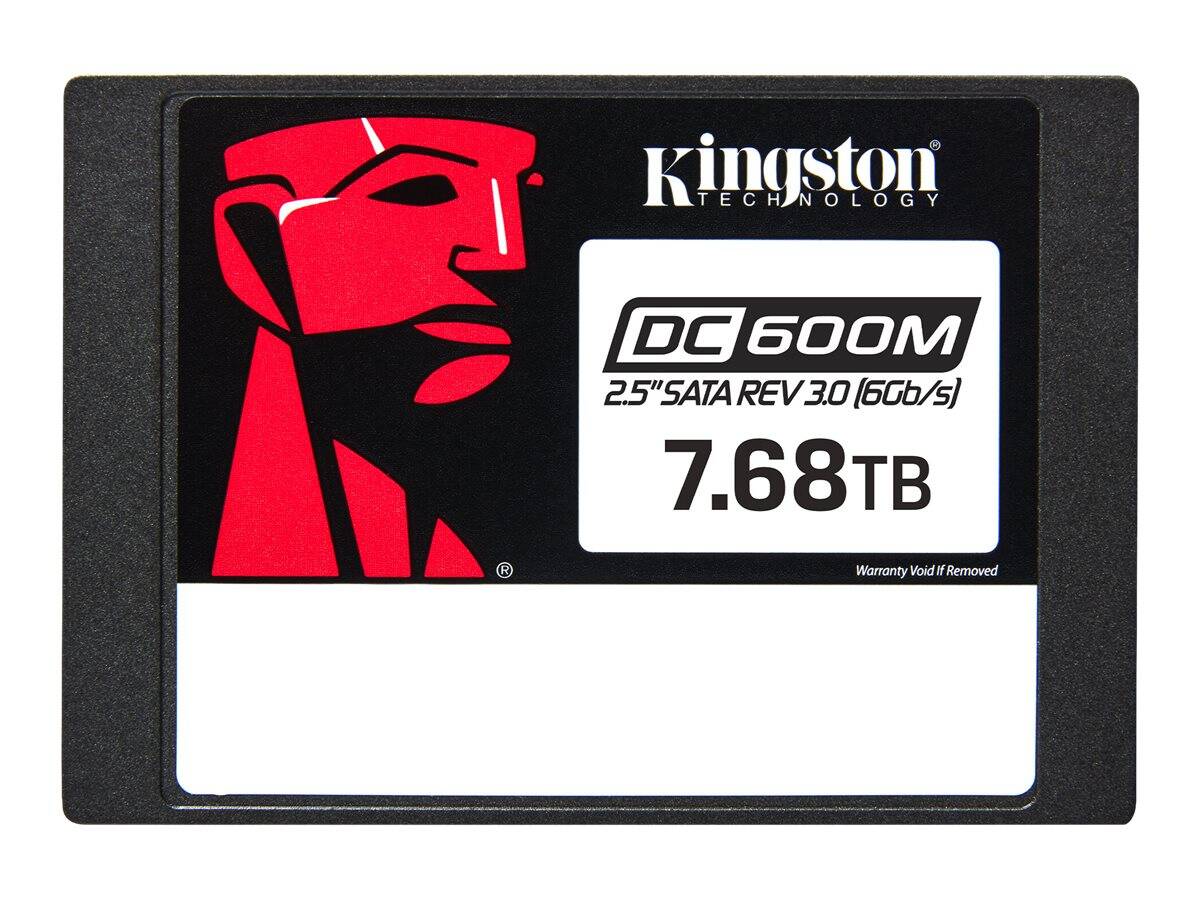
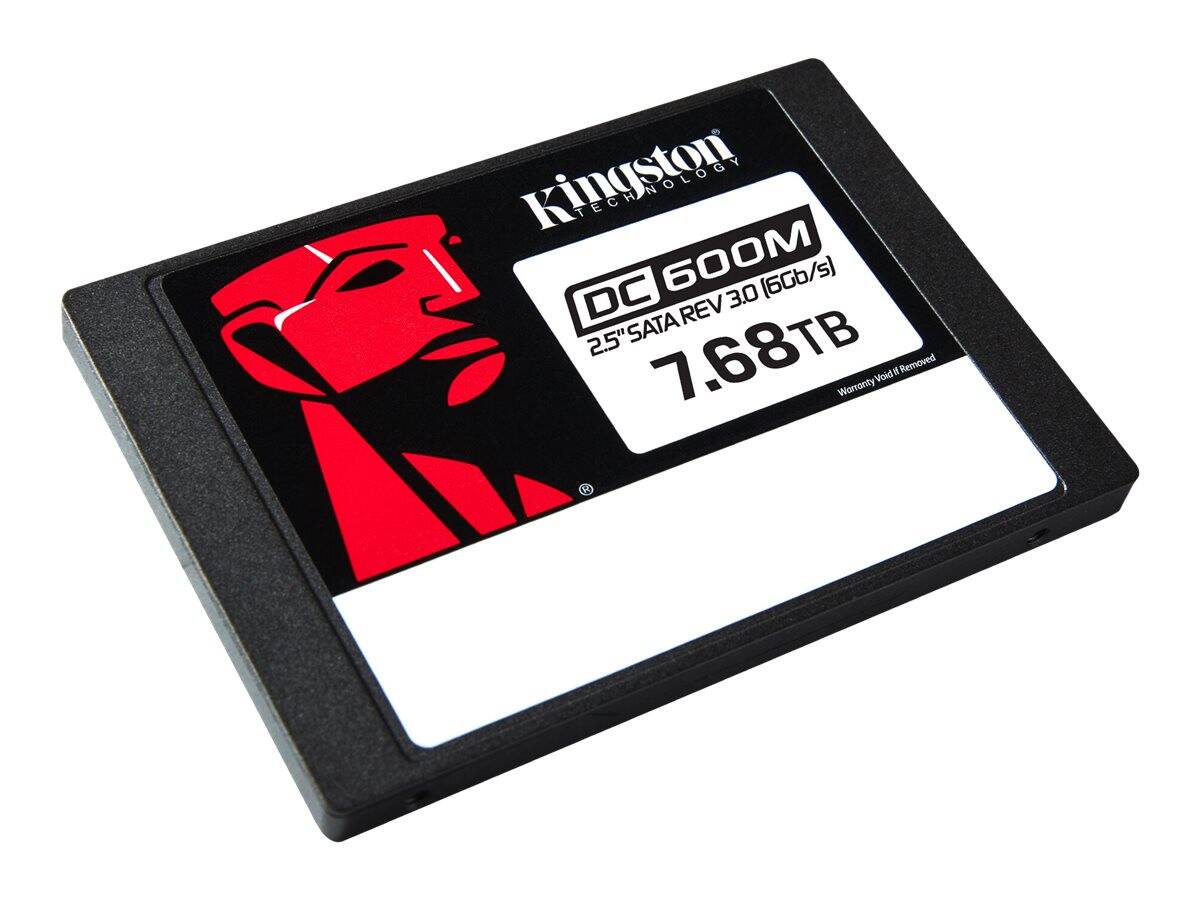
Kingston DC600M 7.68TB SEDC600M-7680G Enterprise SATA SSD 2.5-inch 560 MB/s Read 1 DWPD 14016 TBW
Brand:
Kingston


SEDC600M/7680G
Delivery
Order Today...
Ships...
Delivery...
ℹ️ Large or fragile items (e.g. monitors) may require extra handling time. We'll keep you informed.
Payment options
Trusted Tech Choice
Buying Benefits
Verified
Competitive EU pricing
Delivered to Cyprus from EU stock
Local warranty support
Please sign in so that we can notify you about a reply
Kingston DC600M 7.68TB — Enterprise Mixed-Use SATA SSD, 1 DWPD, 14,016 TBW
7.68TB capacity1 DWPD mixed use14,016 TBW enduranceHardware power loss protection
The Kingston DC600M is a data-centre SATA SSD built for mixed-use server workloads, and this is the 7.68TB model — the largest capacity in the line. It reads at up to 560 MB/s and writes at up to 530 MB/s, delivers 94,000 random read and 34,000 random write IOPS in steady state, and is rated at 1 drive write per day for five years — 14,016 TBW derived from the JEDEC enterprise workload. Nearly eight terabytes on a SATA bay is what this drive is for: capacity in a chassis that has no NVMe backplane, with the endurance and power loss protection a server needs.
Compatibility — check before buying:
This is a standard 2.5-inch 7 mm SATA drive, so it fits any 2.5-inch SATA bay and any SATA port, in a server or a desktop. That makes it the lowest-risk drive in Kingston’s enterprise range to fit. Three things to check anyway. A 9.5 mm-only caddy may need a spacer for a 7 mm drive. SATA 6 Gb/s caps the drive at about 560 MB/s whatever the host — if you need more, the answer is NVMe, not a faster SATA drive. And the one that costs money: the DC600M has no encryption at all. If a compliance requirement calls for a self-encrypting drive, the part you need is the DC600ME, which is the same drive with TCG Opal 2.0 and AES-256 added. The two part numbers differ by two characters and are very easy to mis-order. Tell us the server model and whether encryption is required, and we will confirm the right part before you order.
Best For
✓ Mixed read and write server workloads
✓ Virtualisation hosts and database servers
✓ Replacing enterprise SATA drives in an existing array
✓ Boot and cache drives in racked servers
✓ Systems with no NVMe backplane
✓ Workloads that need published steady-state IOPS
Key Features
1 DWPD and 14,016 TBW, on the JEDEC workload
Endurance is quoted per capacity and against the JEDEC Enterprise Workload JESD219A, not a friendly sequential test. One full drive write a day — 7.68 terabytes — every day, for five years. That is the figure a capacity-planning spreadsheet actually needs.
Steady-state IOPS, and a capacity caveat
94,000 random read and 34,000 random write IOPS in steady state. Worth knowing that Kingston publishes lower random write IOPS as the capacity rises in this line — 78,000 at 1.92TB, 59,000 at 3.84TB, 34,000 here. Counter-intuitive, and it is exactly what Kingston publishes per capacity, so we print it rather than carry a smaller drive’s figure across.
Hardware power loss protection
Kingston publishes hardware-based power loss protection on this drive. When the rack loses power mid-write, data already acknowledged to the host is committed rather than lost. It is the single feature that most separates an enterprise SSD from a desktop one.
Predictable latency and 2 million hours MTBF
Kingston publishes 99.999-percentile QoS latency for this capacity — 240 µs read and 170 µs write, the best in the line — alongside a 2-million-hour MTBF and a UBER of 10⁻¹⁷. Consistency under load is what a fleet is built on.
Technical Specifications
Frequently Asked Questions
Singular Expert Insight
The honest way to judge an enterprise SATA drive is to ignore the 560 MB/s, because every SATA SSD ever made reaches roughly that. The three numbers that matter here are the 1 DWPD / 7,008 TBW endurance on the JEDEC workload, the steady-state random IOPS rather than burst figures, and the presence of hardware power loss protection. That last one is why a drive like this exists: a consumer SSD that loses power mid-write can lose data the host believed was committed, which in a database is a corrupted table rather than an inconvenience. Where SATA itself is the limit, the answer is not a faster SATA drive but a different interface — Kingston’s DC3000ME is the U.2 NVMe drive in the same mixed-use class, though it needs a U.2 backplane and server airflow. See our full enterprise and server SSD range, and if this is going into a NAS rather than a server, our NAS and RAID appliances section lists what each chassis takes.
Buyer’s Guide
Buy it if
You need maximum SATA capacity with real enterprise behaviour: 7.68TB, 1 DWPD, 14,016 TBW, hardware power loss protection and a five-year term, in a chassis that has no NVMe backplane.
Skip it if
A compliance requirement calls for a self-encrypting drive — the DC600M has none, and the DC600ME is the part you want. Skip it too if the workload is write-heavy beyond 1 DWPD, or if you actually need NVMe throughput.
Also consider
The 3.84TB DC600M if random write IOPS matter more than capacity per bay. The Kingston DC600ME if encryption is required. A U.2 NVMe drive if the chassis has the backplane for it.
Features - Kingston - SEDC600M/7680G
Form Factor
- 2.5"
Interface
- SATA
More Details
Product Code
04:430965
EAN Code
0740617334951
Manufacturer
Kingston
Technical specifications
Capacity
8TB