
Silicon Power CreatePro CR60D SP256GBSDXJV6V10 256GB SDXC UHS-II V60 U3 Memory Card Full-Size SD 280/170 MB/s
Brand:
Silicon Power

Silicon Power CreatePro CR60D SP256GBSDXJV6V10 256GB SDXC UHS-II V60 U3 Memory Card Full-Size SD 280/170 MB/s
€328.76 inc. VAT



SP256GBSDXJV6V10
Delivery
Order Today...
Ships...
Delivery...
ℹ️ Large or fragile items (e.g. monitors) may require extra handling time. We'll keep you informed.
Payment options
Trusted Tech Choice
Buying Benefits
Verified
Competitive EU pricing
Delivered to Cyprus from EU stock
Local warranty support
Please sign in so that we can notify you about a reply
Silicon Power CreatePro CR60D 256GB SDXC — UHS-II V60, 280/170 MB/s
280 / 170 MB/sUHS-II · U3 · V60256GB SDXC60 MB/s sustained for 4K
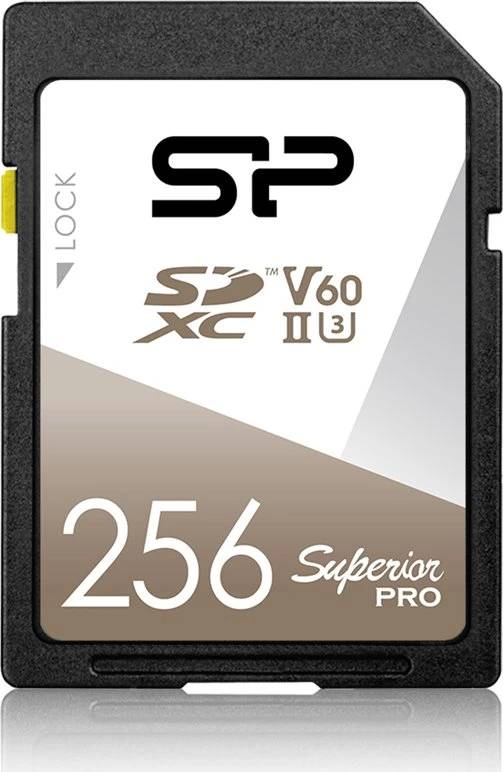
The Silicon Power CreatePro CR60D SP256GBSDXJV6V10 is a 256GB full-size SDXC card on the UHS-II bus, rated Class 10, UHS Speed Class U3 and Video Speed Class V60, and quoted by Silicon Power at up to 280 MB/s read and 170 MB/s write at this capacity. V60 guarantees a 60 MB/s minimum sustained write, which is the level 4K Ultra HD recording and continuous RAW bursts are specified against, so it suits mirrorless and DSLR bodies used for paid work rather than casual snapshots. It is the card Silicon Power sold until recently under the Superior Pro UHS-II name — same part number, current family name CreatePro CR60D.
Compatibility — check before buying:
Watch the name, not just the brand. Many retailers still list this part as “Superior Pro UHS-II”. Silicon Power’s current Superior Pro SD card is a different, much slower product — UHS-I, 90 MB/s read and 80 MB/s write. If you want the fast one, the part number to order is SP256GBSDXJV6V10 and the family name is CreatePro CR60D. Second: UHS-II speed needs UHS-II at both ends. Silicon Power states that a UHS-II host and a UHS-II card reader are both required, and that performance is limited to lower speeds in non-UHS-II devices — the card still works in a UHS-I camera or laptop slot, it simply falls back to the UHS-I bus. Third: this is a full-size SD card, not microSD, so it will not fit a phone, a handheld console or a drone that takes microSD. And if your camera manual asks for V90 — typical of 8K and 4K/120 modes — you need the CR90D instead, not this card. Tell us your camera model and we will confirm the class it needs before you order.
Best For
✓ Mirrorless and DSLR bodies with a UHS-II SD slot
✓ 4K Ultra HD video recording at standard bitrates
✓ Continuous RAW burst shooting where the buffer must clear
✓ Event, wedding and press work with fast card offloads
✓ Photographers who already own a UHS-II card reader
✓ A large working card that still fits in a wallet pocket
Key Features
V60 is a floor, not a headline
The V60 mark means a guaranteed 60 MB/s minimum sustained write, not a best-case number. That is the figure that decides whether a camera keeps recording 4K without dropping frames, and it is why a V-class matters more than a peak read speed for video work.
280 MB/s read on the UHS-II bus
UHS-II adds a second row of contacts along the back of the card. With a UHS-II reader, offloading a full 256GB card takes a fraction of the time a UHS-I card needs — the difference is felt at the end of a shoot, not during it.
170 MB/s write at this capacity
Silicon Power publishes 170 MB/s write for the 256GB and 512GB, and only 100 MB/s for the 128GB. Buying the smaller card in this family buys a slower card as well as less space, which is worth knowing before you pick a capacity.
Built to be carried, not babied
Silicon Power describes the CR60D as waterproof, shockproof, temperature-proof and X-ray-proof, with automatic ECC error correction and a minimum of 10,000 insertion cycles. No IP rating is published, so treat it as resilient rather than submersible.
Technical Specifications
Frequently Asked Questions
Singular Expert Insight
The thing to get right on this card is the name. Silicon Power renamed its professional SD line to CreatePro, so the same part number that shops still list as “Superior Pro UHS-II” is now the CreatePro CR60D — while the card Silicon Power currently sells as Superior Pro is a UHS-I model at 90 MB/s read and 80 MB/s write. Searching by family name can land you on a card three times slower to read; searching by SP256GBSDXJV6V10 cannot. Within the CreatePro range the CR60D is the 4K card and the CR90D is the 8K card, and the honest split between them is the sustained write floor, 60 MB/s against 90 MB/s, not the headline read speed they nearly share. Note too that the 128GB version of this same card writes at 100 MB/s rather than 170, so the 256GB is the first capacity where the family performs as advertised. Browse our full range of SD cards, and if your laptop has no UHS-II slot, pair it with a proper card reader — without one the UHS-II speed stays on the card.
Buyer’s Guide
Buy it if
You shoot 4K video or continuous RAW bursts and your camera has a UHS-II SD slot. You want offload times measured against 280 MB/s rather than 100. You need a day-long 256GB working card for events or press work. You already own, or are willing to buy, a UHS-II card reader.
Skip it if
Your camera manual asks for V90 — 8K, 4K/120, ProRes and RAW modes need the CR90D. Your camera and reader are both UHS-I, in which case you are paying for a bus you cannot use. You need microSD for a phone, drone or handheld console. You are buying for a dashcam or security camera, a use Silicon Power’s warranty terms exclude.
Also consider
The CreatePro CR90D if your camera specifies V90. A UHS-II card reader, without which the 280 MB/s read stays theoretical. A second 256GB card rather than one 512GB, so a card failure never costs you the whole shoot. A cheaper UHS-I card if all you record is Full HD.
Features - Silicon Power - SP256GBSDXJV6V10
More Details
Product Code
04:595274
EAN Code
4713436150145
Manufacturer
Silicon Power
Technical specifications
Capacity
256GB