
Kingston DC3000ME 7.68TB SEDC3000ME-7T6 U.2 PCIe Gen5 NVMe Enterprise SSD 14000 MB/s Read 1 DWPD
Μάρκα:
Kingston
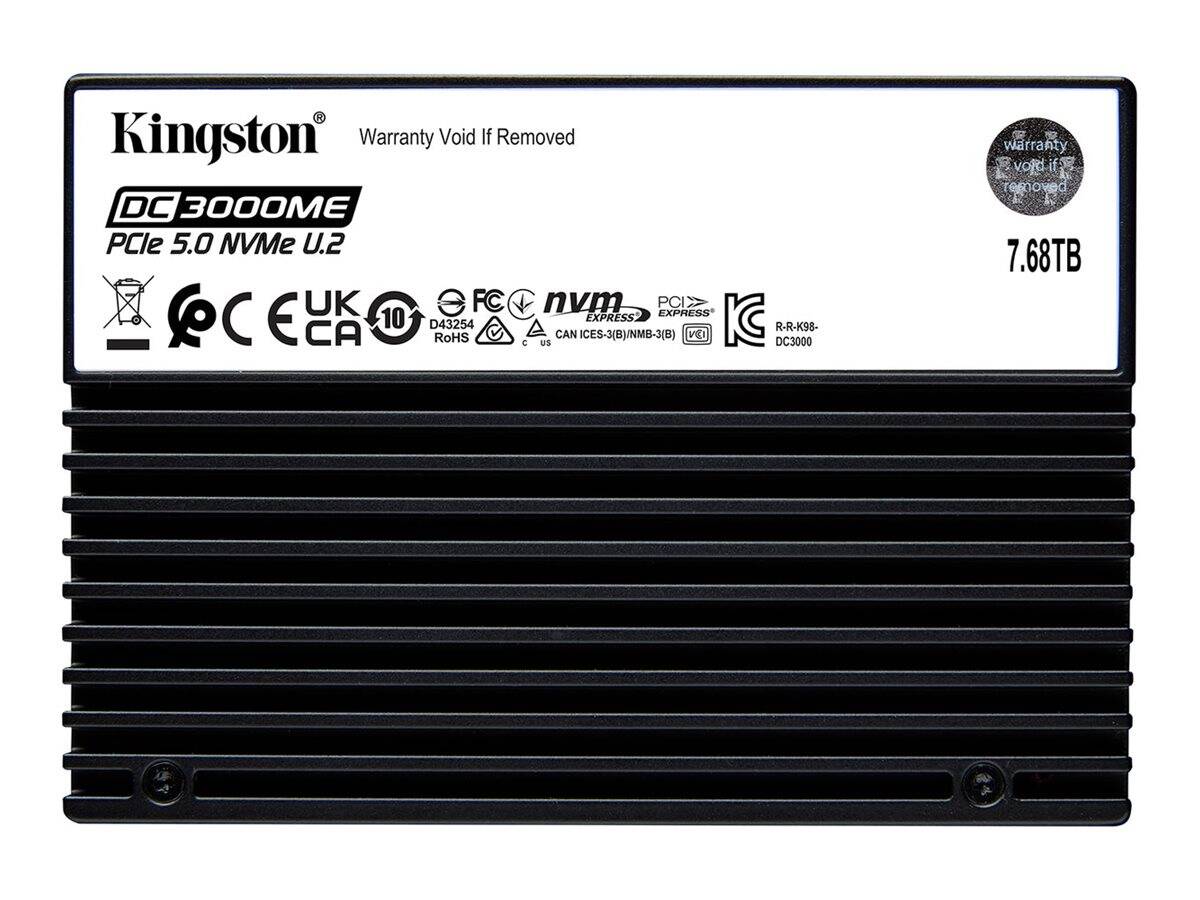
SEDC3000ME/7T6
Delivery
Order Today...
Ships...
Delivery...
ℹ️ Large or fragile items (e.g. monitors) may require extra handling time. We'll keep you informed.
Payment options
Trusted Tech Choice
Buying Benefits
Verified
Competitive EU pricing
Delivered to Cyprus from EU stock
Local warranty support
Συνδεθείτε για να μπορέσουμε να σας ειδοποιήσουμε σχετικά με μια απάντηση
Kingston DC3000ME 7.68TB — U.2 PCIe Gen5 NVMe, 14,000 / 10,000 MB/s, 2.8M IOPS
14,000 MB/s read10,000 MB/s write2.8M random read IOPSPCIe Gen5 x4, U.2
The Kingston DC3000ME is a PCIe Gen5 data-centre NVMe SSD in the U.2 form factor, and this 7.68TB model is the fastest capacity in the line. Kingston publishes up to 14,000 MB/s sequential read and 10,000 MB/s sequential write, with 2,800,000 random read and 500,000 random write IOPS, at 1 drive write per day for five years — 14,016 TBW on the JEDEC enterprise workload. It is a mixed-use, self-encrypting drive: on-board power loss protection with capacitors, TCG Opal 2.0 with AES-256, NVMe-MI 1.2b out-of-band management and 128 namespaces.
Compatibility — check before buying:
Three hard requirements, and each of them stops the drive working if it is not met. First, U.2 is not SATA. The connector is SFF-8639 and it needs a U.2 backplane, a U.2 host card, or an SFF-8643/SFF-8654-to-U.2 adapter cable into a PCIe slot — it will not work in a 2.5-inch SATA bay. Second, it is 15 mm thick and will not physically fit a 7 mm or 9.5 mm bay even with the right cabling; the chassis must accept 15 mm U.2. Third, power and cooling: up to 24 W on write. That needs server-grade airflow and is not viable passively in a quiet desktop case. Two further notes. On a PCIe Gen4 host the drive works — Kingston publishes backwards compatibility — at roughly half the sequential ceiling, so the Gen5 premium only pays on a Gen5 x4 slot. And Kingston publishes no explicit hot-plug statement for this model; hot-swap behaviour depends on your backplane and controller, so we will not promise it. Tell us the server model and backplane type and we will confirm the drive fits before you order.
Best For
✓ Gen5 servers with a U.2 or U.3 backplane
✓ Databases and analytics that are IOPS-bound
✓ Virtualisation hosts needing low, predictable latency
✓ Storage nodes replacing SATA arrays
✓ Workloads that need namespaces and out-of-band management
✓ Sites where drives must be securely decommissioned
Key Features
14,000 read, 10,000 write, 2.8 million read IOPS
This capacity is materially faster than the 3.84TB, which Kingston publishes at 5,800 MB/s write and 300,000 random write IOPS. It is also the highest random read in the whole family at 2.8 million IOPS — ahead of the 15.36TB and 30.72TB models. Buying up in capacity genuinely buys speed here, which is not always true.
Latency measured in tens of microseconds
Kingston publishes 99th-percentile QoS latency of under 70 µs read and under 10 µs write. For a transactional workload, consistent low latency does more for throughput than peak bandwidth ever will.
On-board power loss protection with capacitors
Kingston publishes on-board PLP using power capacitors, so data already acknowledged to the host survives an unexpected power loss. On a drive this fast, with this much in flight, it is not optional.
TCG Opal 2.0, AES-256 and NVMe-MI management
Self-encrypting at full speed, plus NVMe-MI 1.2b out-of-band management, telemetry for media wear and temperature, 128 namespaces and static and dynamic wear levelling. These are the features that make a drive manageable at fleet scale rather than one at a time.
Technical Specifications
Frequently Asked Questions
Singular Expert Insight
Choosing this drive is really choosing an interface. The gap between enterprise SATA and Gen5 NVMe is not the sequential headline — it is 2.7 million random read IOPS against roughly 94,000, and sub-70-microsecond latency instead of hundreds. If your bottleneck is a database waiting on random reads, that is the whole answer. If it is capacity per bay in an existing chassis, a SATA drive such as Kingston’s DC600M is the right tool and this one will not even fit. Two things worth being blunt about. The Gen5 premium only pays on a Gen5 x4 slot — on a Gen4 backplane you are buying headroom for a future rebuild. And 24 W on write demands server airflow; this is not a drive to put on an adapter card in a quiet workstation. Note also that its endurance is 1 DWPD mixed use, not a write-intensive class: for heavy sustained writing the DWPD budget runs out before the performance does. Our full range is in enterprise and server SSDs, and storage controllers and adapter cards covers what a chassis needs to accept U.2 at all.
Buyer’s Guide
Buy it if
Your server has a Gen5 U.2 backplane and your workload is IOPS-bound or write-heavy. 2.8 million random read IOPS, 10,000 MB/s write, TCG Opal 2.0, on-board PLP and 1 DWPD across 7.68TB.
Skip it if
Your chassis has SATA bays or a 7 mm caddy — this drive will not fit or connect. Skip it too if the platform is Gen4 and staying there, or if the workload writes more than 1 DWPD.
Also consider
The 3.84TB DC3000ME if you need less capacity per bay — note it is the slower of the two on writes. The Kingston DC600ME if the chassis is SATA-only. A U.2 host adapter card if the server has no U.2 backplane.
Form Factor
- 2.5"
Interface
- U.2
Technical specifications
Μέγεθος
8TB
Χαρακτηριστικά
Product Code
03:267903
EAN Code
0740617347852
Manufacturer
Kingston