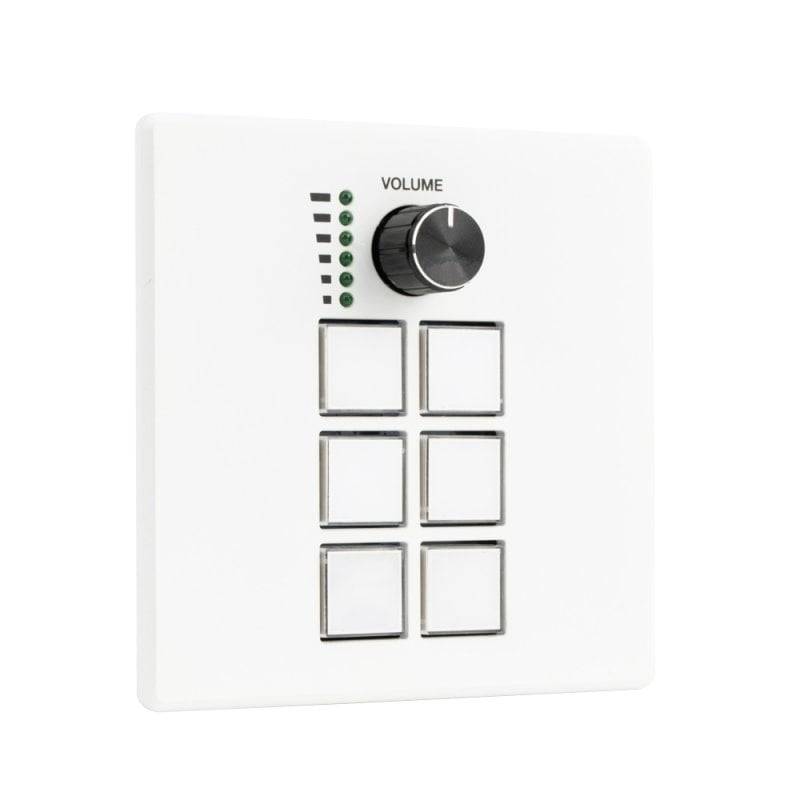
Lindy Control Keypad, 6 Keys and Dial — Programmable AV Room Control, PoE, Wall Mount
6 programmable backlit keysRotary dial with push buttonLAN, RS-232, RS-485, IR, relayPoE 802.3af or 5 V DC
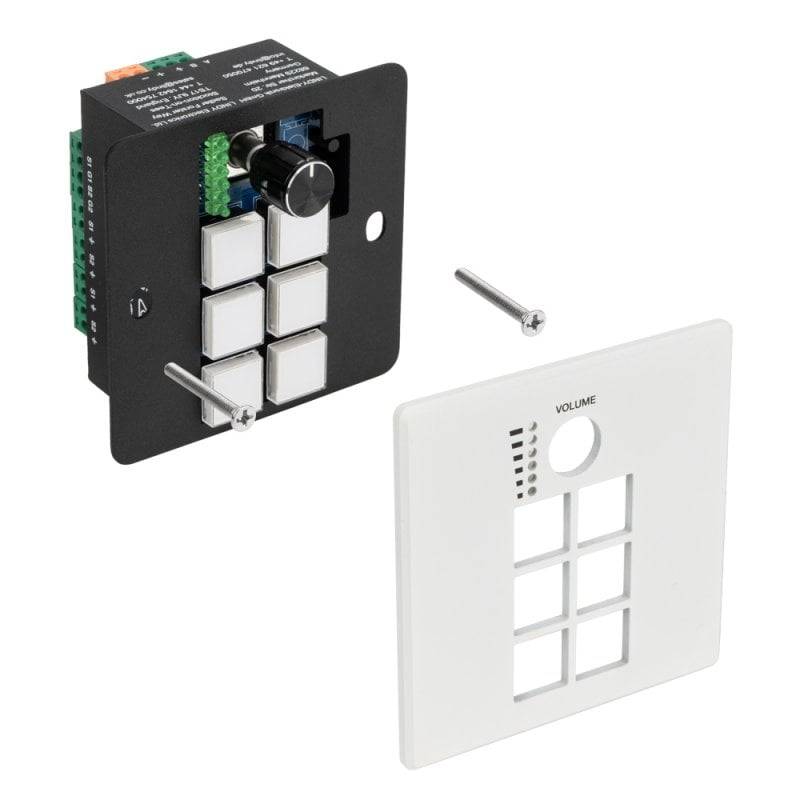
The Lindy Control Keypad with 6 keys and dial, part number 32306, is a programmable wall-mounted controller that gives a meeting room, classroom or lecture theatre a single, obvious interface for everything in it — displays, switchers, audio systems, lighting, projection screens and room automation. Six backlit buttons with custom-labelled caps handle the presets, and an integrated rotary dial with push-button function handles volume and any other continuous adjustment, with status LEDs giving clear feedback. Underneath it is a proper control processor rather than a dumb button panel: an ARM Cortex-A7 at 1.2 GHz running Linux, with 100 Mbps LAN over RJ-45, four RS-232 ports, one RS-485, two IR outputs, relay outputs and two configurable I/O ports, all on Phoenix terminal blocks. Programming is done in Lindy Pro Control software. It runs on PoE 802.3af or the included 5 V DC multi-country power supply, in a compact metal enclosure of 86 x 86 x 52.7 mm. Lindy backs it with a 3-year warranty. Typically in stock with fast delivery across Cyprus.
Compatibility — check before buying:
Read this as an installer’s component, not a consumer product. It does nothing out of the box — every button, the dial and every control interface has to be programmed in Lindy Pro Control software against the specific devices in your room. Budget for that configuration work, or buy it through an integrator. Three other points worth knowing before ordering. It is a keypad, not a touch panel: there is no screen, so feedback is limited to the backlighting and status LEDs — if you need menus or a graphical interface, Lindy’s Control Touchpad models are the alternative. The network port is 100 Mbps, which is ample for control traffic but is not Gigabit. And the USB-C connector is a debug port, not a general data or power connection. Power is PoE 802.3af or 5 V DC 1 A; the multi-country PSU is supplied, so PoE is a convenience rather than a requirement. Operating range is 0 °C to 40 °C at 10–90% RH non-condensing, which is an indoor, climate-controlled specification.
Key Features
Six programmable backlit keys with custom caps
The caps are labelled for the room, so the interface reads “Presentation”, “Video Call”, “Blinds” rather than “Input 1”. That is the difference between a control system people use and one they call IT about — and the backlighting means it is findable in a dimmed lecture theatre.
Rotary dial with push-button function
A physical dial for volume is the one control that a touch screen genuinely does worse. It is adjustable without looking at it, it has no lag, and it can be reassigned in software to any continuous function — lighting level, screen position, camera zoom.
Six control interfaces in one unit
LAN, four RS-232 ports, RS-485, two IR outputs, relay outputs and two configurable I/O ports. That combination covers essentially the whole installed base: IP-controlled displays and switchers, serial projectors and audio DSPs, IR-only legacy kit, and dry-contact devices such as screens and blinds.
Runs Linux on an ARM Cortex-A7
A real control processor with 256 MB RAM and 256 MB flash, not a keypad that simply closes contacts. Logic, macros and device drivers execute on the panel itself, so a room keeps working even when the network or a central controller does not.
PoE 802.3af, with a PSU in the box as well
One Cat.6 cable can carry both power and control to the wall plate, which is what makes retrofitting a keypad into an existing room practical. Where PoE is not available, the included 5 V multi-country supply covers it — you are not forced into one method.
Compact metal enclosure, 86 x 86 mm
A standard square wall-plate footprint in metal rather than plastic, 52.7 mm deep, at 260 g. It fits the same aperture as conventional wall plates and stands up to a decade of daily pressing in a public room.
Technical Specifications
| Identification |
| Brand |
Lindy |
| Model |
Control Keypad, 6 keys and dial |
| Part Number |
32306 |
| EAN / Barcode |
4002888323062 |
| Processing |
| CPU |
ARM Cortex-A7 1.2 GHz |
| Operating System |
Linux |
| RAM |
256 MB |
| Flash Memory |
256 MB |
| Programming |
Lindy Pro Control software |
| Network |
| Standard |
PoE 802.3af |
| Supported Bandwidth |
100 Mbps |
| Maximum Distance |
100 m (393.7 ft), point to point |
| Transmission Medium |
Cat.6 |
| Control Interfaces |
| Network |
1 x RJ-45 with PoE |
| Serial |
4 x RS-232 (3-pin terminal block); 1 x RS-485 (3-pin terminal block) |
| Infrared |
2 x IR out (2-pin terminal block) |
| Relay |
Relay output (4-pin terminal block) |
| I/O |
2 x configurable I/O in/out (2-pin terminal block) |
| Service |
1 x USB-C debug port (female) |
| Power Input |
2-pin terminal block |
| User Interface |
| Buttons |
6 programmable backlit keys with custom-labelled caps |
| Dial |
Rotary dial with push-button function |
| Indicators |
Status LEDs |
| Physical and Environmental |
| Dimensions (W x D x H) |
86 x 86 x 52.7 mm (3.39 x 3.39 x 2.07 in) |
| Housing Material |
Metal |
| Net Weight |
0.26 kg (0.57 lb) |
| Colour |
White |
| Power Requirements |
5 V DC 1 A, or PoE 802.3af |
| Operating Temperature |
0 °C to 40 °C (32 °F to 104 °F) |
| Storage Temperature |
-20 °C to 60 °C (-4 °F to 140 °F) |
| Humidity |
10–90% RH, non-condensing |
| MTBF |
More than 30,000 hours |
| In the Box |
| Contents |
1 x control keypad; 5 x 3-pin 3.5 mm Phoenix connector (male); 1 x 4-pin 3.5 mm Phoenix connector (male); 4 x 2-pin 3.5 mm Phoenix connector (male); 1 x 2-pin 3.81 mm Phoenix connector (male); 2 x wall mounting screws; 1 x 5 V 1 A multi-country power supply with 2-pin 3.81 mm Phoenix connector; 1 x quick installation guide |
| Packaging |
Carton box, 185 x 135 x 75 mm |
| Gross Weight |
0.31 kg (0.68 lb) |
| Compliance |
| Certification |
CE, UKCA, FCC, RoHS, REACH, California Proposition 65 |
| Warranty |
| Warranty |
1-Year Warranty (Singular) |
| Manufacturer Term |
Lindy publishes a 3-year warranty on this product. Singular’s direct warranty is 1 year; beyond that we assist you with the manufacturer’s warranty process for its full duration. |
Frequently Asked Questions
Does it work straight out of the box?
No, and that is by design. Every key, the dial and each control interface must be programmed in Lindy Pro Control software against the actual devices in the room. That is what makes it flexible enough to drive a projector over RS-232, a display over IP and a screen over a relay from the same panel — but it does mean commissioning work is part of the job.
What is the difference between this and a control touchpad?
This is a keypad: six physical buttons and a dial, with no screen. A touchpad gives you menus, source lists and graphics. The keypad wins where the room needs a handful of reliable, obvious actions that anyone can operate without instruction, and where a screen would be an invitation to get lost. Lindy makes 4-inch and 10-inch touchpads for the other case.
Can I power it over the network cable?
Yes — it supports PoE 802.3af, so a single Cat.6 run carries power and control up to 100 m. A 5 V 1 A multi-country power supply is also supplied in the box, so if the switch feeding the room is not PoE-capable you can still install it conventionally.
Which devices can it actually control?
Anything reachable over the interfaces it provides: IP-controlled displays, switchers and DSPs over LAN; projectors, screens and audio processors over its four RS-232 ports or RS-485; legacy equipment through the two IR outputs; and dry-contact devices such as motorised screens, blinds and relays through the relay and I/O ports. That mix is what lets one keypad run a mixed-vintage room.
What is the USB-C port for?
Debugging and service, not power or general data transfer. Power comes from PoE or the supplied 5 V DC input, and configuration is delivered over the network from Lindy Pro Control software.
Is it suitable for a lectern or a desk?
It is designed for wall mounting, in an 86 x 86 mm square format with two mounting screws supplied. For a desk or lectern position, Lindy’s 10-inch desktop control touchpad is the product designed for that placement.
Singular Expert Insight
Room control lives or dies on the interface, and the industry has spent twenty years relearning that a small number of clearly labelled buttons beats a complicated screen for the majority of rooms. A six-key panel with a volume dial is the right answer for a meeting room where people need to start a presentation, join a call, adjust the volume and leave — nobody should need training to use a room. What makes this particular unit worth its price is what is behind the buttons: four RS-232 ports, RS-485, IR, relay and configurable I/O alongside the network port, which means it can drive a room full of equipment from different decades without a separate control processor in the rack. The two things to plan for are the commissioning, because Lindy Pro Control programming is not optional, and the placement, because this is a wall-mount panel with no screen. Browse our
commercial monitors range for the displays it controls, and see our
network switches section for the PoE switch that powers it over a single cable.
Buyer's Guide
Buy it if
You are fitting out a meeting room, classroom, lecture theatre or hospitality space and want one wall-mounted panel that controls displays, audio, lighting and screens over IP, serial, IR and relay — and you have someone to programme it.
Skip it if
You need a graphical interface with menus and source lists, or a desk-mounted controller — Lindy’s 4-inch and 10-inch control touchpads cover those. Also skip it if nobody in the project will do the Pro Control programming.
Also consider
Lindy Control Touchpad 4 inch for a wall-mounted screen interface, the 10-inch desktop control touchpad for lecterns and tables, or PoE network switches to power and connect the keypad over one cable.