
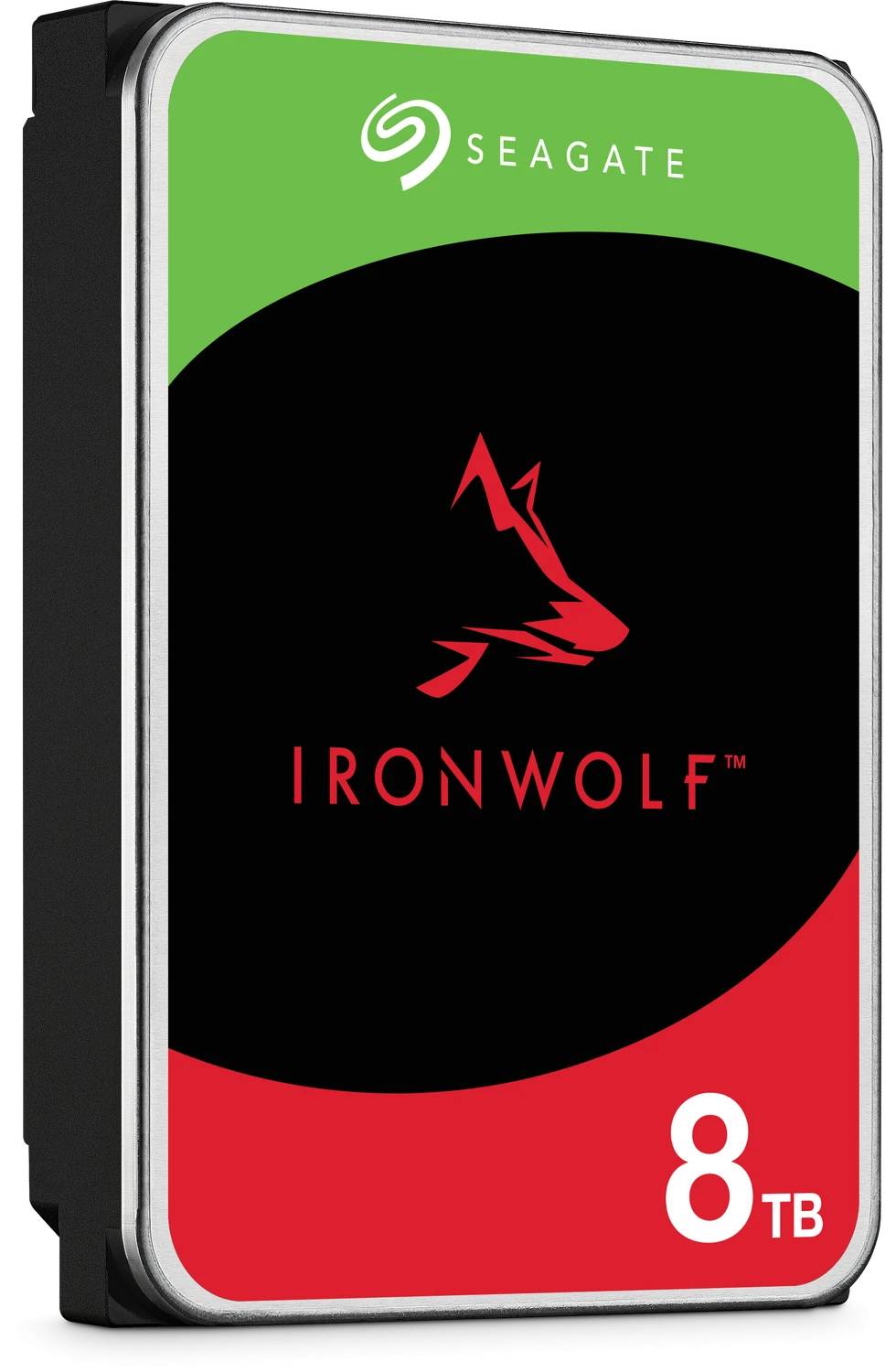
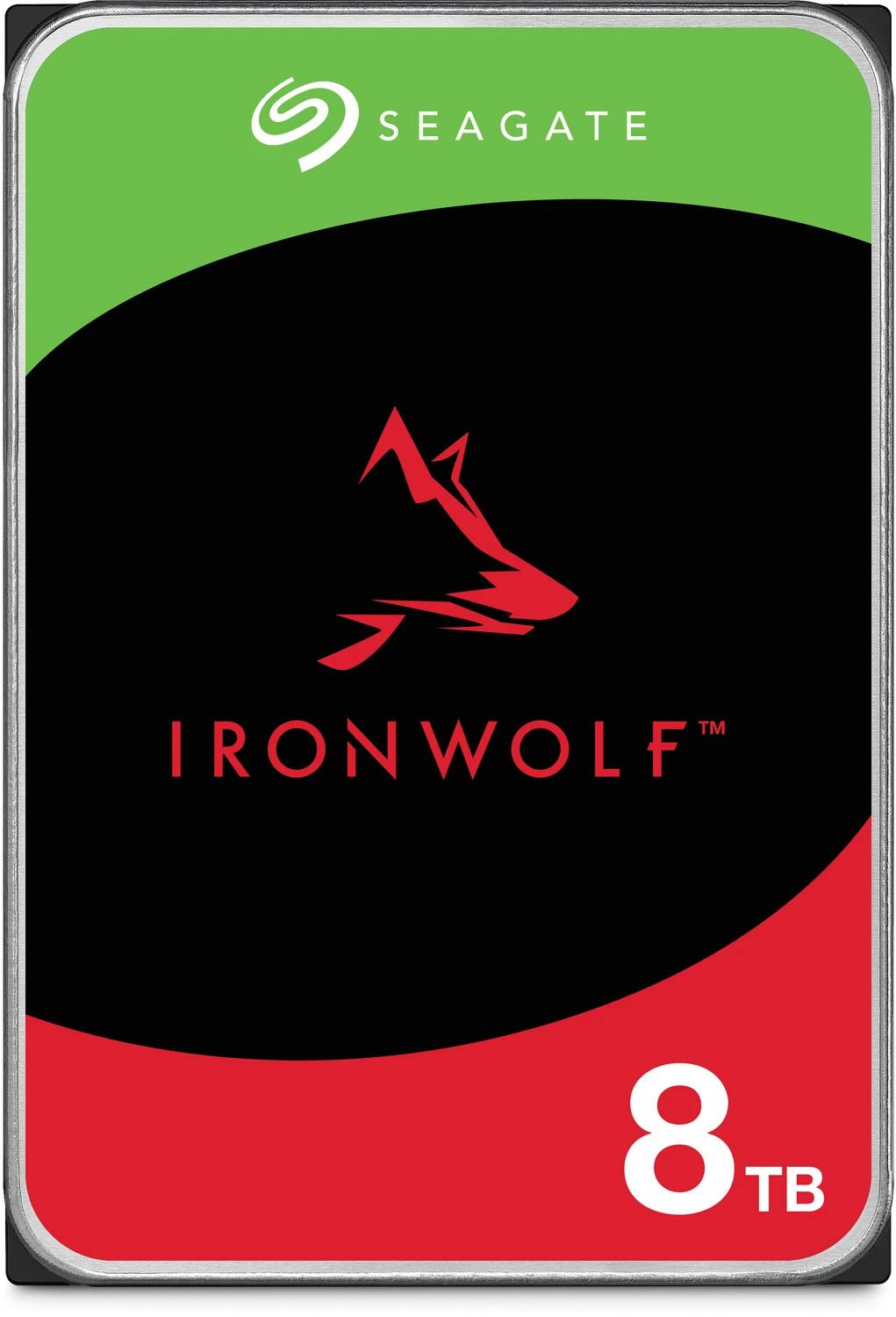
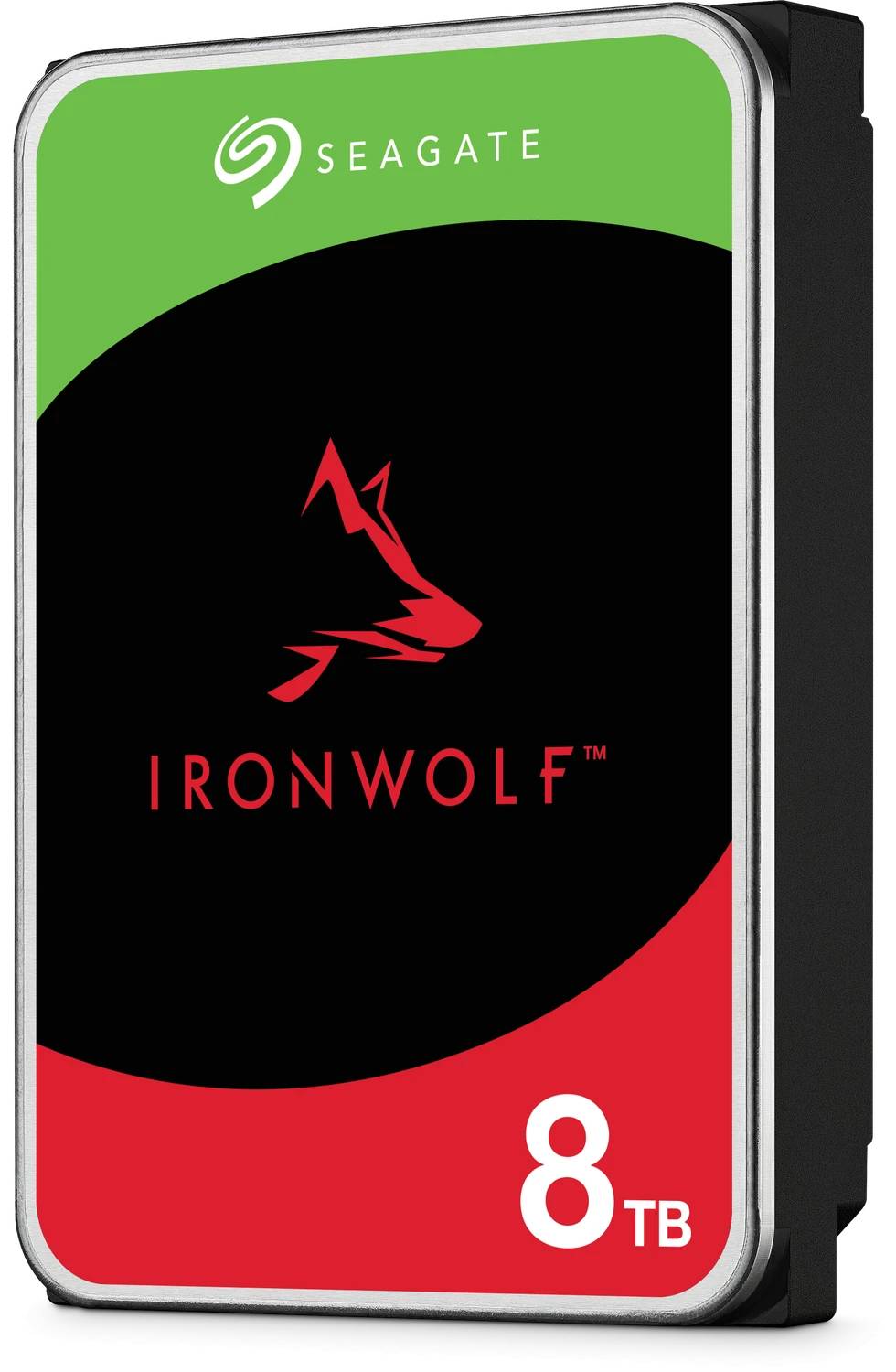
Seagate IronWolf ST8000VN004 8TB 3.5 inch SATA 6Gb/s NAS Hard Drive CMR 7200RPM 256MB Cache 8 Bays
Brand:
Seagate

Seagate IronWolf ST8000VN004 8TB 3.5 inch SATA 6Gb/s NAS Hard Drive CMR 7200RPM 256MB Cache 8 Bays
€461.64 inc. VAT


ST8000VN004
Delivery
Order Today...
Ships...
Delivery...
ℹ️ Large or fragile items (e.g. monitors) may require extra handling time. We'll keep you informed.
Payment options
Trusted Tech Choice
Buying Benefits
Verified
Competitive EU pricing
Delivered to Cyprus from EU stock
Local warranty support
Please sign in so that we can notify you about a reply
Seagate IronWolf 8TB — ST8000VN004 NAS Hard Drive
8TB 3.5" SATA 6Gb/sUp to 8 Drive Bays180 TB/Year, 24x7CMR with RV Sensors
The Seagate ST8000VN004 is a 8 TB 3.5-inch IronWolf NAS hard drive for small and mid-sized network storage that runs continuously — rated for a 180 TB annual workload across 8760 power-on hours, in enclosures of up to eight drive bays. Seagate lists it under part number ST8000VN004; the EAN on this listing is 8719706009812. It is a conventional-recording (CMR) drive at 7200 RPM with a 256 MB cache, rotational vibration sensors and AgileArray firmware, and it ships with three years of Rescue Data Recovery Services. It is the 7200 RPM member of the 8 TB IronWolf pair, on the Gen 10 platform with 10 heads across 5 discs. Typically in stock with fast delivery across Cyprus.
Compatibility — check before buying:
This is IronWolf, not IronWolf Pro, and the gap between them is the thing to understand before buying. IronWolf is rated at 180 TB per year with a 1,000,000-hour MTBF, a 0.87% annualised failure rate and a ceiling of eight drive bays. IronWolf Pro is rated at 550 TB per year, 2,000,000 to 2,500,000 hours depending on capacity, and unlimited bays. The warranty differs too: three years here against five on Pro. Listings that quote 300 TB per year, 1.2 million hours or "up to 24 bays" against an IronWolf part are carrying across figures from the Pro range or from its older NE generation. Two different 8 TB IronWolf drives exist, and this is the faster, hotter, older one. The ST8000VN004 runs at 7200 RPM with 10 heads on 5 discs, reaches 210 MB/s, draws 10.1 W under load, makes 28 dBA at idle, and — the specification that actually matters in a large array — has an unrecoverable read error rate of 1 per 10E15. The newer ST8000VN002 runs at 5400 RPM on 8 heads and 4 discs, draws 5.3 W, makes 25 dBA, but its error rate is 1 per 10E14, an order of magnitude worse. Neither is simply better. One commercial note: this part number has dropped out of Seagate’s current EU price lists while the VN002 remains, so long-term availability for matched array expansion is less certain. Seagate has published no formal end-of-life notice. Two points of accuracy: Rescue Data Recovery is included on current IronWolf drives for three years — older reseller copy claiming non-Pro has no Rescue is out of date — but Seagate’s footnote adds it is not available in all countries. And Seagate does not state whether this drive is helium-filled or air-filled, so we do not claim either.
Best For
✓ Two- to eight-bay NAS enclosures running continuously
✓ Home and small-office file, media and backup servers
✓ RAID sets where rebuild reliability matters — 1 error per 10E15 bits
✓ Multi-drive chassis with vibration — RV sensors are fitted
✓ Media libraries that outgrew a desktop drive
✓ Anyone wanting a NAS-rated drive with data recovery included
Key Features
Rated for continuous NAS duty
IronWolf is built for 8760 power-on hours a year at a 180 TB annual workload — a genuine 24x7 rating, unlike desktop drives rated for roughly 2400 hours. AgileArray firmware adds dual-plane balancing, RAID-optimised error recovery and time-limited error recovery, so the drive does not drop out of an array while retrying a sector. IronWolf Health Management reports on prevention, intervention and recovery on supported NAS platforms.
Eight bays, with rotational vibration sensors
Seagate rates IronWolf for enclosures of one to eight bays, and this capacity has rotational vibration sensors fitted — not universal in the family, since the 1 TB and 2 TB models lack them. That combination is what makes a four- or six-bay chassis practical without the spindles interfering with each other. Beyond eight bays, IronWolf Pro is the rated product.
CMR at 7200 RPM, with the better error rate
This is a conventional magnetic recording drive spinning at 7200 RPM with 256 MB of cache across 10 heads and 5 discs, reaching 210 MB/s maximum and 200 MiB/s at the outer diameter. Its unrecoverable read error rate of 1 per 10E15 is ten times better than the newer 8 TB IronWolf’s, which is the figure that decides whether a large RAID rebuild completes cleanly. Sector format is 512e.
Three years of Rescue Data Recovery included
If the drive fails, Seagate’s Rescue service applies its recovery technology and returns what it can retrieve. Current IronWolf drives include three years of it — a change from the older generation, where Rescue was a Pro-only feature, and one that a good deal of reseller copy has not caught up with. Seagate’s footnote states the service is not available in all countries, so confirm availability rather than assuming coverage.
Technical Specifications
Frequently Asked Questions
Singular Expert Insight
IronWolf is the honest choice for a small NAS, and the wrong one for a growing array. What you are buying over a desktop drive is a genuine 24x7 rating, AgileArray firmware that will not drop a drive out of a RAID set mid-recovery, and rotational vibration sensors — all of which matter from the second drive onwards. What you are not buying is headroom: 180 TB a year and an eight-bay ceiling are real specifications, and a busy eight-bay box doing constant writes will sit closer to them than most people expect. At 8 TB you have a genuine choice between two IronWolf drives. This one is faster and has the better error rate, at the cost of roughly double the power and noticeably more noise — the right pick for a cupboard or rack. If the NAS sits in a room people use, the quieter ST8000VN002 is the better neighbour. Compare the range in our NAS hard drives, and if the destination is a rack rather than a NAS chassis, the enterprise and server hard drives range is where the 550 TB workload ratings live.
Buyer’s Guide
Buy it if
You are filling a two- to eight-bay NAS that runs continuously and you want a drive actually rated for it: 180 TB per year, 8760 power-on hours, CMR, rotational vibration sensors, AgileArray firmware and three years of Rescue Data Recovery included. At 7200 RPM with a 1 per 10E15 error rate it is the more robust of the two 8 TB IronWolf drives for a large array.
Skip it if
Your enclosure holds more than eight drives, or the array does heavy sustained writing — both are outside what Seagate rates IronWolf for, and IronWolf Pro is the correct tier at 550 TB per year with unlimited bays. Skip it too if the drive is going into a desktop that is off overnight, where a BarraCuda costs less, or into a surveillance recorder, where SkyHawk is the right family.
Also consider
ST8000VN002 is the other 8 TB IronWolf — 5400 RPM, half the power at 5.3 W, quieter at 25 dBA, but with a 1 per 10E14 error rate, and it is the one still in Seagate’s current EU line-up. ST8000NT001 is the IronWolf Pro at the same capacity, with 550 TB per year, unlimited bays and a five-year warranty. ST8000NE001 is the previous-generation Pro at 8 TB.
Features - Seagate - ST8000VN004
Form Factor
- 3.5",
- Internal
Interface
- SATA
More Details
Product Code
04:324498
EAN Code
8719706009812
Manufacturer
Seagate
Technical specifications
Capacity
8TB