TRENDnet TI-SG104 — Industrial Gigabit PoE++ Splitter
IEEE 802.3bt input12/16/24/48V DC outGigabit dataDIN-rail · IP30 metal
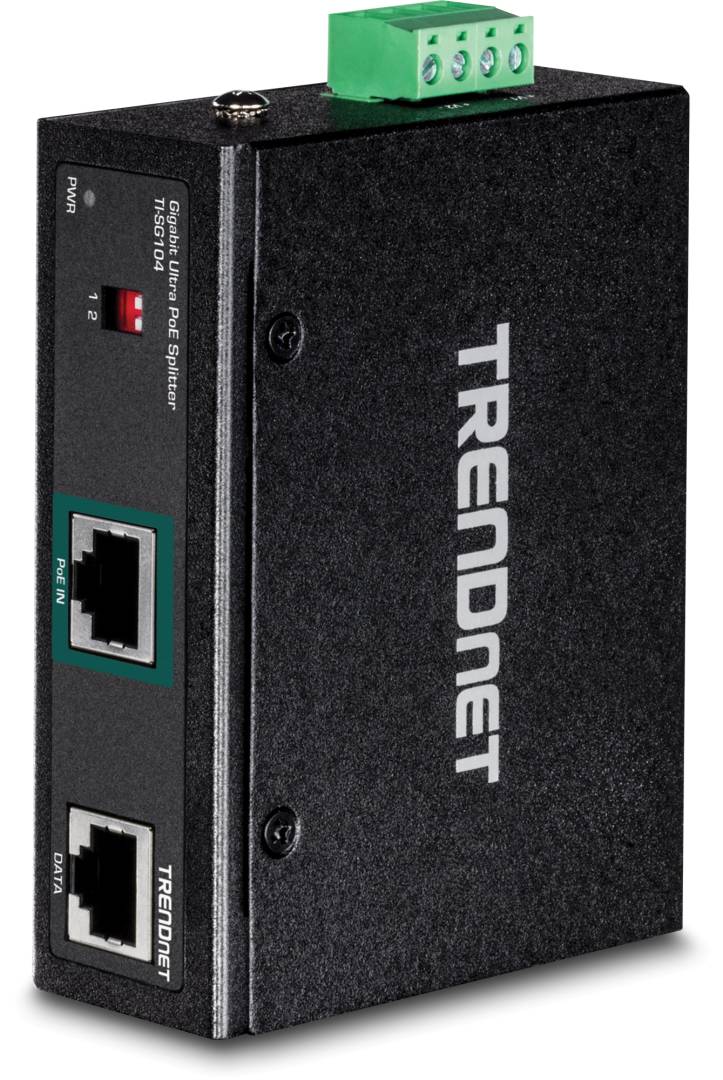
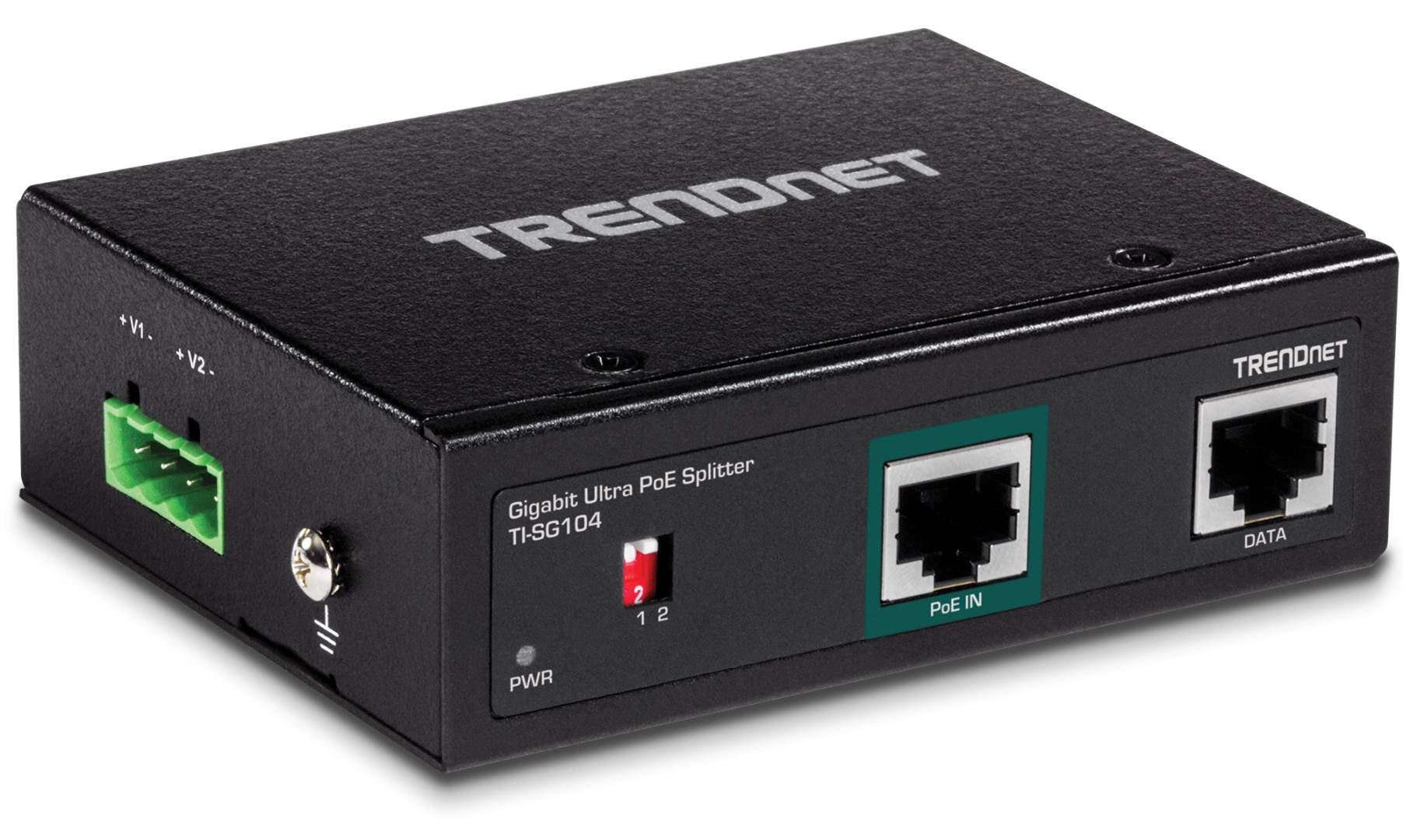
The TRENDnet TI-SG104 is an industrial Gigabit PoE++ splitter that takes power and data from a single PoE cable and separates them into a Gigabit Ethernet port and a DC power output, so you can run a non-PoE camera, controller, sensor or access point from a PoE switch or injector up to 100 m away. It is built for control cabinets and harsh locations: IP30 metal housing, DIN-rail or wall mounting and a -40 to 75 °C operating range.
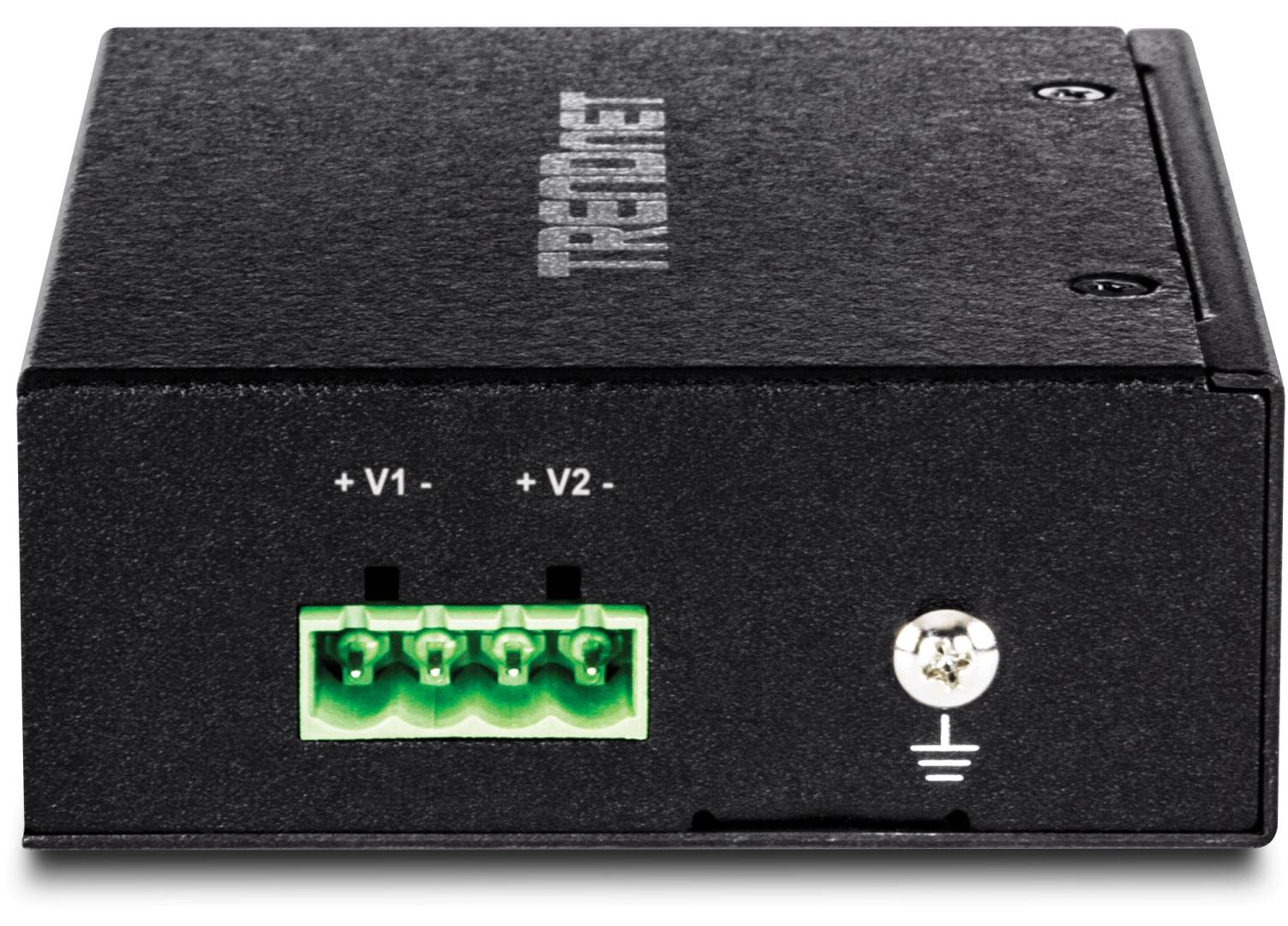
A DIP switch sets the DC output to 12 V, 16 V, 24 V or 48 V, and the removable 4-pin terminal block gives a dual DC output, so one PoE++ port can feed up to two low-power devices at the same voltage. The available output depends on what the PoE source can deliver: the higher the PoE class at the input, the more power you get out.
Before you order: The output power is limited by your PoE source. An IEEE 802.3bt (PoE++) switch or injector gives the most headroom; on an 802.3af or 802.3at port the splitter still works but delivers much less power. Check your device's wattage before ordering.
What's in the Box
- TI-SG104 industrial PoE++ splitter
- Removable terminal block (DC output)
- DIN-rail and wall-mount kit
- Quick Installation Guide
What It Means in Practice
- Put a PoE++ switch in the main cabinet and power a 24 V or 12 V industrial device in a remote cabinet with one Ethernet cable — no local mains outlet or separate PSU needed.
- Set the DIP switch before connecting the load: 48 V is the factory default, so a 12 V device must be switched to 12 V first.
- Wire the DC output with 0.34–2.5 mm² (12–24 AWG) conductors on the terminal block; the metal case has a grounding point for cabinet earthing.
- The Gigabit data port passes the network straight through to the device, so the device appears on the network exactly as if it were connected to the switch.
What Will Not Work
- It is not a PoE injector or switch — it needs an IEEE 802.3af/at/bt PoE source on its input; a normal non-PoE switch port will not power it.
- Passive (non-standard) 24 V PoE injectors are not listed as a supported source.
- It does not supply PoE on its output — the device gets plain DC on the terminal block, not PoE on the RJ45 port.
- A device that needs more power than your PoE source class can provide will not run reliably; a 15.4 W 802.3af port leaves only about 10 W for the load.
Key Features
PoE++ input
Accepts IEEE 802.3af, 802.3at and 802.3bt PoE, and is best paired with a PoE++ switch or injector for maximum output power.
Selectable DC output
DIP switch for 12, 16, 24 or 48 V DC via a removable terminal block with dual output.
Industrial build
IP30 metal housing, DIN-rail or wall mount, -40 to 75 °C operating temperature, surge protection.
Gigabit pass-through
Gigabit Ethernet data on the output port for cameras, controllers and access points.
Technical Specifications
| Identification |
| Part Number |
TI-SG104 |
| Brand |
TRENDnet |
| Type |
Industrial Gigabit PoE++ splitter |
| Connectivity |
| PoE input |
1 × Gigabit RJ45 PoE in (IEEE 802.3af / 802.3at / 802.3bt) |
| Data output |
1 × Gigabit RJ45 (data only) |
| DC output |
Removable 4-pin terminal block, dual DC output |
| Standards |
IEEE 802.3, 802.3u, 802.3ab, 802.3af, 802.3at, 802.3bt |
| Max distance |
100 m from the PoE source |
| Electrical |
| Output voltage |
12 V / 16 V / 24 V / 48 V DC (DIP switch, 48 V default) |
| Max output current |
12/16/24 V: 2.3 A · 48 V: 1.25 A |
| Output power |
Depends on the PoE class of the source — highest with an 802.3bt source |
| Wiring |
0.34–2.5 mm² (12–24 AWG) |
| Surge protection |
2 kV |
| Physical |
| Housing |
IP30 metal |
| Mounting |
DIN rail or wall |
| Dimensions |
104 × 82 × 32 mm |
| Operating temperature |
-40 to 75 °C |
| Humidity |
Up to 95 % non-condensing |
| Certifications |
CE, FCC |
| Warranty |
| Warranty |
1-Year Warranty (Singular) |
| Manufacturer Term |
3-year limited warranty per TRENDnet — claims handled through Singular |
Frequently Asked Questions
Can one TI-SG104 power two devices?
Yes, the terminal block has a dual DC output at the voltage you select, as long as the combined load stays within what your PoE source delivers.
What happens if I connect it to an 802.3at (PoE+) switch?
It works, but the PoE+ port supplies around 30 W, so the DC output available to your device is roughly 22–25 W rather than the 50 W+ you get from a PoE++ source.
Do I still need a power supply in the cabinet?
No. The splitter takes all its power from the Ethernet cable, which is the whole point — only the PoE switch or injector at the other end needs mains power.
Singular Expert Insight · Buyer's Guide
Most problems with PoE splitters come from the source, not the splitter: an 802.3af/at port simply cannot deliver what a 24 V industrial device needs. Pair the TI-SG104 with a PoE++ switch from our
switches range and set the voltage before you connect the load.
✓ Buy it if you need to run a 12/24/48 V non-PoE device in a remote cabinet from an existing PoE++ switch or injector.
✕ Skip it if your PoE source is 802.3af only and the device needs more than about 10 W, or the device itself already supports PoE.
→ Also consider an industrial PoE++ injector if your switch has no PoE, or a DIN-rail power supply when mains power is available at the device.
Not sure your PoE switch can drive your device? Send us the switch model and the device wattage and we will check before you order.